
by Sharon Soileau 01-11-2009 02:00 AM
Race horses are athletes. They begin training at an early age to develop bone density, ligament and tendon strength, as well as muscle tone. As these areas are being prepared for racing, a trainer must also build up cardiovascular fitness. This process of preparing a horse for his first race usually takes around 10-12 months to accomplish.
There are, however, individuals who believe these crucial steps can be skipped. By doing so, it puts the horse, his competitors, and the jockeys in the race at risk. Skipping these building blocks would be equivalent to a weekend jogger attempting to compete in a marathon.
Proper conditioning not only includes a strenuous exercise schedule, scientifically designed diet, hoof and leg care, but a horse must also learn to carry himself in a manner that will develop all his muscles, especially the back and hindquarters. The rear end is his engine. If not maintained, it will sputter and stall out.
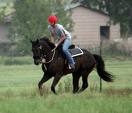
When a horse gallops, he needs to "bow" or arch his neck. This puts him in the correct body frame to lift and round out his back, which in turn, will allow for his hindquarters to come up underneath him so he can push off and drive forward. This will also help the animal to lift his shoulders for better extension of his forelegs. All of this equals forward propulsion with a long, ground-eating stride.
If the equine athlete is not taught the proper body frame, or collection, they get "strung out". A horse that is strung out will gallop along with his neck stuck straight out. Some will carry their heads up high, bouncing along in a gait that resembles a pogo stick, while some go along with their heads too low. These horses tend to stub their toes and stumble often. In either case, they are not gathering themselves up to propel forward. They tend to expend a great deal of energy because their backs are hollowed out, or sunk in, and they are pulling themselves along with their front legs. This causes a shortened stride, making them work twice as hard to cover the same amount of ground as the horse who uses himself properly.
There are some people, owners and trainers alike, who think that all of this is unnecessary. All too often I hear the comment, "Just gallop them a couple of months and run them fit". First of all, two months of galloping, even if it is done correctly, will be no where near enough conditioning for a horse to compete in a race. Second, the "run them fit" statement is absurd. A leading cause of injury is fatigue. When the soft tissue tires, it can't support the bone. This leads to over extension of the joints, which will cause bones to chip and fracture. The unfit horse will maybe be able to run about three eighths of a mile before his super-fit foes leave him behind. Some horses, if subjected to this several times, will learn to only run a portion of the race at full speed, and then call it quits for the day as an "also-ran" horse.
Jockeys don't want to ride unfit horses. They typically finish out of the money and never learn how to be competitive. I once heard a jockey tell the trainer that his horse had finished last so many times, the horse thought that's what he was supposed to do. Owners get frustrated paying expensive training bills while his pride and joy gets dirt thrown in his face on race day. No one wants to be part of the losing team.
No man in his right mind would walk in off the street and expect to be able to compete in a professional ball game. Why should they expect the horses to do the very thing they would not do?
www.sharonsoileau.com/distantrumblings
Published 01-11-2009 © 2026 Access Athletes, LLC
Disclaimer:
Access Athletes, LLC owns the exclusive copyright to all information contained within the articles posted on The Real Athlete blog. All information is for the End user's use only and may not be sold, redistributed, or otherwise used for commercial purposes without the expressed consent of Access Athletes, LLC. The information is an educational aid only and it is not intended as and nor shall it be construed as legal, medical, financial, psychological or other professional advice or treatment for individual situations, conditions, or predicaments. The information provided in The Real Athlete blog articles shall not constitute an attorney-client, doctor-patient, psychologist-patient relationship or any other professional-client relationship for that matter. The End user shall seek the advice or treatment of his or her own qualified licensed professional(s) and the End user shall not rely on the information contained herein as such. End users who leave comments on the blog articles or email the contributors personally shall have no expectation of privilege or confidentiality. Additionally, we strongly recommend that you consult your doctor, nurse, nutritionist or pharmacist before following any of our workout or nutrition regimens to ensure that it is safe and effective for you.
Access Athletes, LLC makes no representation or warranties as to the information, opinions, or other services or data you may access, download or use as a result of accessing The Real Athlete blog. All implied warranties of merchantability and fitness for a particular purpose or use are hereby excluded. Access Athletes, LLC does not assume any responsibility for your use of or reliance on any of the information provided by The Real Athlete blog.